 B.C. v. Steak & Shake involved a late-filed summary judgment response. The unsuccessful appellant sought rehearing en banc, which led to another opinion. Among other matters, the Court declined to consider a “supplemental clerk’s record” containing information about the logistics of the filing, when that material was not before the trial court or the Fifth Court at the time of its opinion. The Court quoted Chief Justice Hecht’s statement on the general subject in Worthy v. Collagen Corp., 967 S.W.2d 360, 366 Tex. 1998): “Supplementation of the record after a case is decided is a different matter. It certainly does not serve judicial economy for the appellate court to allow a supplementation of the record that would require it to reconsider its decision on the merits when the party has had ample opportunity to correct the omission prior to decision.” 967 S.W.2d 360, 366 (Tex. 1988). No. 05-14-00649-CV (Oct. 27, 2017) (suppl. op. on rehearing).
Category Archives: General Court Information
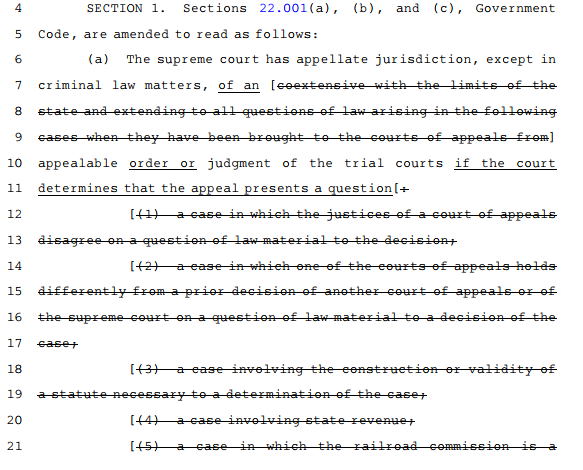
 The Legislature recently streamlined the statute about Texas Supreme Court jurisdiction – the actual bill enacting the new law (below) is a masterpiece of editing for succinctness!
 Of interest to all appellate practitioners, particularly those who may be planning on becoming board certified – the Fifth Circuit describes its newly-created Pro Bono Program as follows. Great opportunity for quality appellate experience!
“The Program assists the Court by facilitating the appointment of pro bono counsel to represent pro se litigants. Pro Bono Panel members will, at the Court’s invitation, be appointed in civil appeals that, for example, present issues of first impression, complex facts or legal questions, or potentially meritorious claims warranting further briefing and/or oral argument.
Pro bono appointments are made by the Court, and are limited to proceedings before this Court. Although oral argument is not guaranteed, cases selected for the Program are likely to meet the Court’s criteria for granting oral argument.
Attorneys wishing to join the Pro Bono Panel should submit to the CMJS Office a cover letter (including statement of types of cases, if any, that counsel prefers or does not prefer), resumé, writing sample (appellate brief or brief of substantive motion), and statement of good standing in the Fifth Circuit Bar. Applications for panel membership should be emailed to the CMJS Office at probono@ca5.uscourts.gov. Questions about the program may be directed to Kate Clark, Administrative Attorney, at that email address or by telephone at 504-310-7799.”
 Today’s Dallas Observer has an excellent story about the City of Dallas’s $4 billion back pay dispute with police and firefighters, part of which is set for trial in December 2017 in Collin County. The case involves issues addressed by the Fifth Court in 2002 (yes, 2002) in Arredondo v. City of Dallas, 79 S.W.3d 65 (Tex. App.–Dallas 2002, pet. denied). Specifically, the Court found the word “maintained” to be patently ambiguous as used in this part of a 1978 ordinance: “The current percentage pay differential between grades in the sworn ranks of the Dallas Police Force and the Fire Fighter and Rescue Force shall be maintained.”
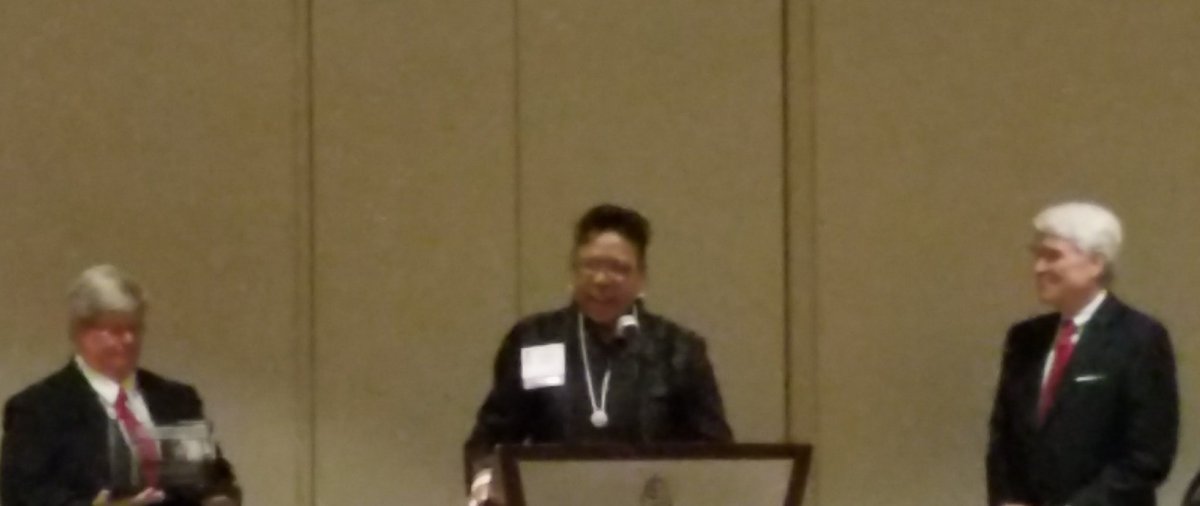 Last week, the Supreme Court of Texas Historical Society gave its annual Jack Pope Professionalism Award to Hon. Carolyn Wright, Chief Justice of the Dallas Court of Appeals. Wonderful recognition for a distinguished public servant.
New Local Rule 5, which became effective in May 2017, bridges a “gap” in the Texas Rules of Appellate Procedure about the briefing schedule when both parties have appealed.
I am speaking on the topic “Ethics 2017: Recent Federal Court Decisions to Know” on Friday, May 5, to the Plano Bar Association (noon at Palio’s Pizza, yum) – here is the PowerPoint that I will be using.
 The Fifth Court is the first appellate court in Texas to offer an extension of TAMES that allows attorneys to see non-public documents; here is the official announcement.
The oral argument in the high-profile partnership dispute of Enterprise Products Partners LP v. Energy Transfer Partners LP will proceed at 3:00 on Wednesday, April 20, 2016. (LPCH represents Appellee ETP.)

Celebrate St. Patrick’s Day with five recent cases to know from the Dallas Court of Appeals; click here to access the list and analysis. And watch out for leprechauns!
 Does a limitation of liability provision include gross negligence claims? This basic question of contract drafting finds surprisingly little answer in Texas authority. A recent article by LTPC attorneys David Coale and Mallory Biblo summarizes the opinions and where the Dallas Court of Appeals falls.