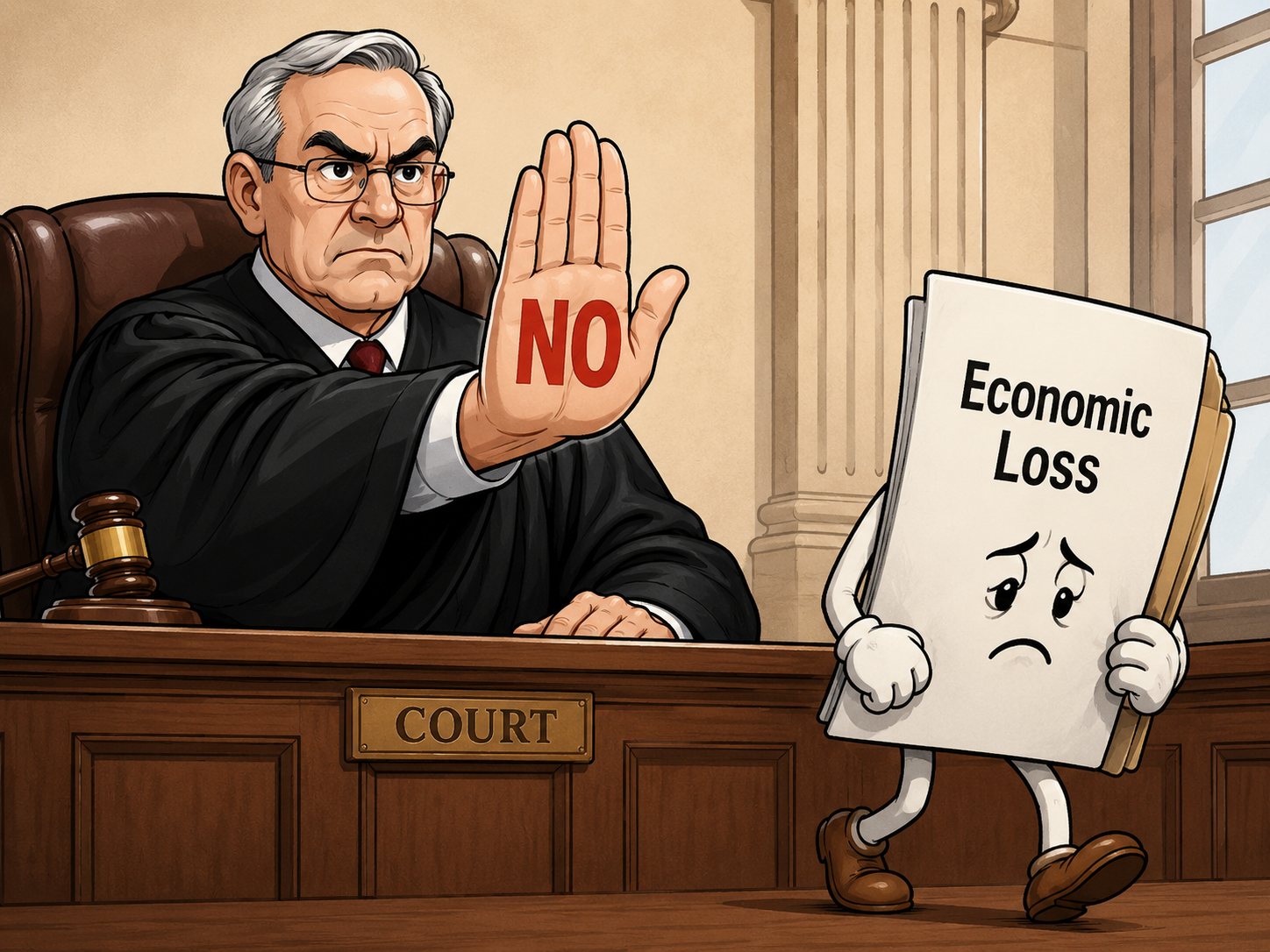
In Kinder Morgan Treating LP v. North Park Advantage Walden MRU, LLC, the Fifth Court held that the economic loss rule barred a negligent misrepresentation claim arising from erroneous gas-recovery simulations provided during negotiation of an equipment lease. The lessee sought to recover over $5.6 million in reliance damages after a simulation error caused it to dramatically overestimate the profitability of a gas processing plant.

The Court observered that the parties had used their agreements to allocate the very risk at issue: the lessee had tried during negotiations to make the lessor warrant the simulation results, but the lessor refused, and the lessee chose to proceed anyway under contractual language disclaiming any representation or warranty that the equipment would produce the simulated results. Therefore, held the Court, allowing the tort claim would “disrupt the allocation of risk the parties negotiated and agreed upon.”

It also rejected the argument that the lessor breached an “independent, pre-contractual legal duty,” noting that the factual bases for both the contract and the negligent misrepresentation claims were identical and that the lessee was, in essence, seeking to recover in tort what was expressly excluded by the contract’s limitation of liability provision. No. 05-24-01447-CV (Jul. 1, 2026) (applying, inter alia, the Fifth Court’s 2024 opinion in Wal-Mart v. Xerox that provided a through review of the economic-loss rule).

In Wal-Mart Stores, Inc. v. Xerox State & Local Solutions, Inc., on remand from the Texas Supreme Court, the Fifth Court concluded that various tort claims were precluded by the economic-loss rule in the context of the particular industry involved:

It is inappropriate for the courts of Texas to disrupt the system of agreements of the different states with Xerox for protection of those states’ retailers. Nor is it appropriate for Texas’s courts to provide common-law protection for Wal-Mart when the statutes, regulations, and contracts governing the SNAP EBT program failed to do so. We conclude the economic loss rule precludes our finding Xerox had a general common-law duty to prevent Wal-Mart’s losses from the store-andforward transactions subject to Xerox’s second motion for summary judgment.

No. 05-18-01421-CV (Dec. 12, 2024) (mem. op.). LPHS represented Xerox in this appeal.

A warehouse owner sued Rhino, a provider of waterproof roof coatings, for negligence for recommending an allegedly substandard contractor. The trial court rendered a substantial judgment for the owner and the Fifth Court affirmed in Rhino Linings Corp. v. 2×2 Partnership, Ltd.

Rhino argued that the negligence claim was foreclosed by a warranty that established “THE SOLE AND EXCLUSIVE AGREEMENT, REMEDY AT LAW OR IN EQUITY FOR DEFECTS IN MATERIAL SUPPLIED BY RHINO.” (The legal effect of CAPITALIZING CONTRACT TERMS I leave for another day.)

The Fifth Court disagreed, concluding that the owner’s claim did not involve “defects in material,” but rather “its reliance on Rhino’s knowing misrepresentation concerning Potter’s being qualified to apply Rhino’s products on 2X2’s roof, which led to 2X2’s hiring him.”

One year ago, the Dallas Court of Appeals held that a homeowner’s negligence claims against the company that installed the home’s plumbing were barred by the economic loss doctrine. Today, the Texas Supreme Court has reversed that ruling in a per curiam opinion. Although the plumber’s liability to the homebuilder was contractual, the negligent performance of a contract that injures a non-party’s person or property is sufficient to state a claim for negligence. The Supreme Court reiterated that the economic loss rule does not permit a party to avoid tort liability to the rest of the world simply by entering into a contract with another person.

Chapman Custom Homes, Inc. v. Dallas Plumbing Co., No. 13-0776

Pursuant to a contract with Chapman Custom Homes, Duncan Plumbing installed the plumbing in a house Chapman was building in Frisco, Texas.  But a year-and-a-half later, those pipes sprung a leak and damaged the house.  The Court of Appeals, however, found that Chapman could not recover for negligence because the economic loss rule bars such a tort claim where a contract governs the parties’ relationship.  The Court rejected Chapman’s argument that the economic loss rule only bars recovery for damages to the “plumbing system itself” (while its damages based on injuries to the entire home), because “the only duty [Chapman] alleged Dallas Plumbing breached was its contractual duty.”

Chapman Custom Homes v. Dallas Plumbing Co.