The Fifth Court addressed a recurring issue in departing-employee litigation in Layla’s Day Spa, Inc. v. HD Salon Group, LLC, in which it reversed the trial court’s judgment on the plaintiff’s claims for tortious interference with contract and prospective business relations.

To establish tortious interference with an existing contract, there must be proof of a willful and intentional act of interference, and for interference with prospective business relations, the conduct must be independently tortious or unlawful. Here, the court found no evidence that the defendants “solicited or encouraged” the technicians to leave their employment, nor that they “knowingly induced” any breach of contract. In fact, the technicians themselves testified that they left for their own reasons, and the plaintiff failed to present any specific facts showing improper conduct by the defendants.

The Court also reminded: “A tortious interference claim cannot be premised merely on the hiring of an at-will employee.” No.  05-24-00065-CV, May 21, 2025

The picayune, yet longstanding, distinction in Texas jury-charge practice between “objecting” and “requesting” jury questions/instructions reared its head again in Shawnee Inc. v. Kaz Meyers Properties, LLC. There, a request for an instruction about mitigation of damages was held insufficient to preserve error, even though the text of the requested instruction was dictated into the record. No. 05-23-00507-CV (July 10, 2025) (mem. op.).

In Feed Energy Co. v. Rodriguez, the Fifth Court addressed whether Texas courts could exercise personal jurisdiction over an out-of-state feed manufacturer whose product ultimately ended up in Texas and allegedly caused injury.

The Court emphasized that, under the “stream-of-commerce-plus” test, it is not enough for a defendant to foresee that its products might end up in Texas; rather, there must be evidence that the defendant specifically intended to serve the Texas market.

The Court found that the feed manufacturer’s actions—such as obtaining a Texas feed license, paying inspection fees, and knowing that some products might end up in Texas—did not amount to purposeful availment of the Texas market. The decision to ship the product to Texas was made unilaterally by a third party after the sale was completed in Iowa, and the manufacturer had no control over the product’s final destination. No. 05-24-01121-CV, July 11, 2025 (mem. op.)

In re Brooks summarizes authority on the practical, and not always remembered, requirement that matters in a mandamus petition have been presented to the trial-court judge; i.e.: “[A] relator may not raise challenges for the first time in a mandamus petition.” The opinion also acknowledges that “[o]n rare occasions we have relaxed this predicate when the circumstances confirmed that the request would have been futile and the refusal little more than a formality.” No. 05-25-00321-CV (July 3, 2025) (mem. op.).

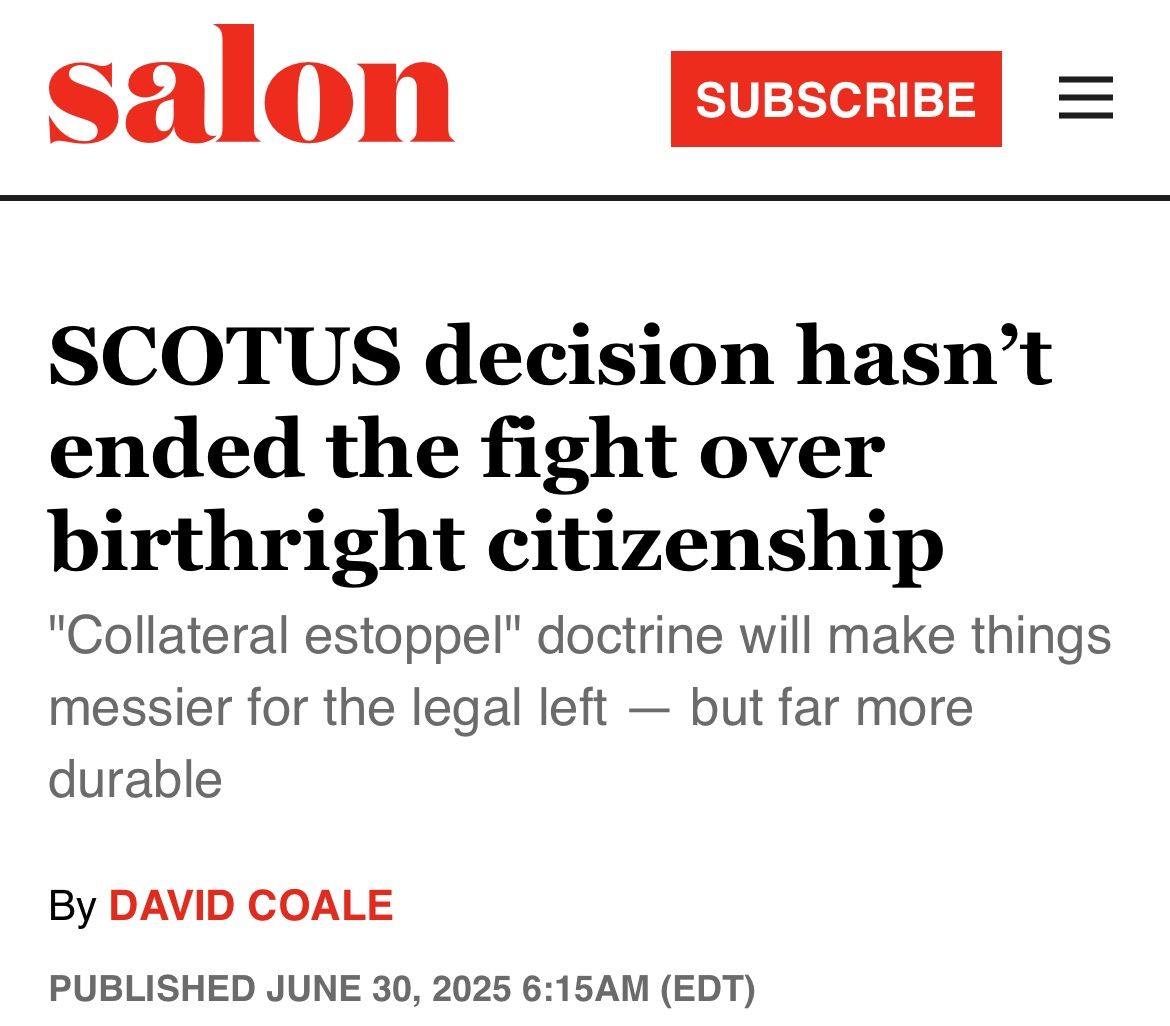
Class-action litigation has drawn considerable attention after Trump v. CASA limited the use of nationwide injunctions. Another tool for expanding the impact of a given case is collateral estoppel, and that’s the subject of this article that I recently published in Salon.