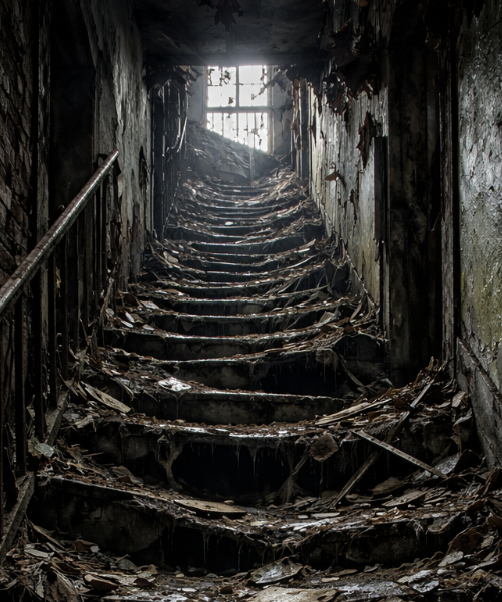
Born v. Fielder involved a premises-liability claim, brought by a prospective home buyer, who fell down three stone steps while exiting the backyard through a gate during a property viewing. The buyer argued that the steps were concealed and created an unreasonable risk, but the trial court and Fifth Court disagreed, applying the rule that a premises owner “has no obligation to warn … or make the premises safe, as a matter of law” when a hazard is open and obvious.

The Court reviewed photographs submitted by the buyer (which he cited as evidence that the stairs were hidden), and concluded that they depicted “an ordinary gate in an ordinary wooden privacy fence” with steps in good condition leading down to the driveway. Other, undisputed testimony established that no other injuries had occurred on the stairs or anywhere else on the property. No. 05-25-00239-CV (Mar. 24, 2026).


SL Nabors Commercial/Residential Roofing, Ltd. v. Allen, discussed yesterday, also involved a minor but technically important issue about the treatement of costs in a judgment: “Although the trial court determines whether a party is the ‘successful’ party and entitled to costs, the taxing or tabulation of costs is determined by the clerk, not the court.”  Accordingly, a judgment should tax costs against a side, but not award a specific amount of costs, and the Fifth Court deleted a sentence from the judgment under review that did award a specific cost amount. No. 05-24-00854-CV, Mar. 26, 2026.

In SL Nabors Commercial/Residential Roofing, Ltd. v. Allen, the Fifth Court rejected sufficiency challenges to a jury’s non-economic damage awards (distinct awards totalling $665,000 for past and future physical pain, mental anguish, and physical impairment).

The Defendants argued that under Gregory v. Chohan, a jury may not “simply pick a number and put it in a blank” when awarding non-economic damages,. The Court acknowledged recent appellate opinions that upheld non-economic awards where plaintiff’s counsel had offered the jury a “simple calculation,” such as a specific dollar amount per waking hour or per day — but held:

“[W]e do not interpret Gregory as changing the law to require such evidence to uphold non-economic damage awards. Rather, these cases illustrate one method by which a plaintiff may assist the jury in calculating damages. When, as here, the reasons given for the award are rational and grounded in the evidence and do not partake of prohibited motives, we defer to the factfinder’s verdict.”

No. 05-24-00854-CV, Mar. 26, 2026.

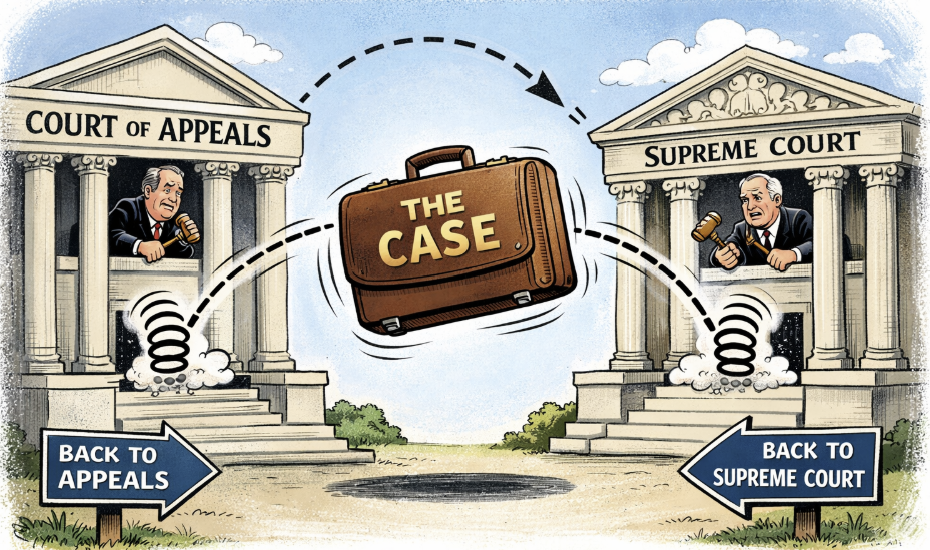
The unfortunate case of Landry v. Landry came to an end before the Texas Supreme Court, after two reviews by the Fifth Court, with the supreme court holding as follows (citations omitted):

        The court of appeals erred when it “substitute[d] its judgment for that of the” trial court. It did not carry out our prior instruction to “perform a new sufficiency analysis” including the four months of account statements that were before the trial court as fact-finder. It instead treated those statements it believed were missing as dispositive, even though they were in fact before the trial court, and even though Rice testified that they would not have altered his expert conclusions. This exemplifies the type of appellate second-guessing our precedents forbid. 
        We now choose to make our Court “the final stop for this litigation.” Reviewing the above evidence in the light most favorable to the trial court’s decision, as we must, we conclude that the trial court could have reasonably formed a firm belief or conviction that the two investment accounts at issue are properly characterized as separate property. Accordingly, there is no basis to disturb its judgment.

No. 24-0910 (Tex. March 20, 2026).

Rehab Squad General Contractors v. Phamily Captai Partners addresses preservation of charge error for a party with the burden of proof.

The Fifth Court held that under Texas Rule of Civil Procedure 278, a party seeking reversal based on an omitted jury question must request and tender that question in writing and in substantially correct form. Mere objection to the omission is insufficient; objection preserves error only when the omitted question is one relied upon by the opposing party.

The court rejected arguments that compliance was impossible or impracticable under the circumstances. Even though the trial court made mid-trial comments suggesting the question would likely be submitted, those statements only “highlighted the necessity” for counsel to be prepared to timely submit a proper question. The trial court explicitly reminded counsel of the need to submit a proposed question and even referenced an available pattern jury charge, yet counsel still did not tender one.

in sum: “Request and tender of a question complying with Rule 278 by the party with the burden of proof on the question is required to preserve the right to complain of a trial court’s failure to submit a question; whereas, an objection is required to preserve a complaint as to a defective question.” No. 05-25-00091-CV, Mar. 17, 2026. Thanks to Ben Taylor for drawing this case to my attention!

Equinor Energy LP v. Lindale Pipeline, LLC provides a textbook illustration of the Texas Supreme Court’s commitment to plain meaning in contract interpretation.The question was whether an energy company breached an exclusivity clause by buying water from third-party suppliers for its fracking operations.

The dispute centered on the phrase “on the Pipeline” in the contract’s exclusivity provision, which made Lindale the “sole and exclusive water provider and pumper on the Pipeline.” The Court held that this phrase refers only to water conveyed through the defined Pipeline infrastructure—not to water supplied to oil wells merely because they are attached to or near the Pipeline.

Finding that the contract’s text was unambiguous, the Court determined as a matter of law that Equinor’s wells fell outside the scope of the exclusivity clause, meaning Equinor was free to purchase water from other suppliers without breaching the agreement. Lindale argued that it would not have agreed to the contract—which required a $1.2 million capital investment and below-market pricing—if it didn’t have exclusive rights to supply water to the wells themselves. The Court was unmoved, emphasizing that it has “no business rescuing parties from contracts that turned out to be bad deals in the name of utilitarianism or equity.” No. 24-0425; Mar. 13, 2026.

In Sanchez v. La Hacienda LLC, the Fifth Court reaffirmed the Texas “natural accumulation rule,” holding that a premises owner has no duty to protect invitees from naturally occurring ice, regardless of whether the owner had advance knowledge of an incoming winter storm.

The appellant argued that the rule should not apply when a landlord knows a dangerous ice condition is “actively forming and worsening” during a prolonged weather event, rather than appearing unexpectedly overnight. The Court rejected this distinction, finding that “nothing in [the supreme court’s leading case] suggests the duration or severity of the storm was legally significant.” Instead, the Court emphasized that ice “results from precipitation beyond a premises owner’s control” and that invitees “are at least as aware as landowners of the existence of [ice] that has accumulated naturally outdoors and will often be in a better position to take immediate precautions against injury.”

No. 05-25-00572-CV, Mar. 10, 2026.

In Crutcher v. City of Fort Worth, the Fifth Court addressd the enforcement of a settlement agreement. As to the issue of consent, the Court held the question is “whether the trial judge possesses information clearly sufficient to put her on notice that a party’s consent is lacking.” Here, the plaintiff filed a response claiming that the settlement failed, the parties never agreed on all material terms, and fraud tainted the agreement. This was enough to signal lack of consent, and the trial court abused its discretion by enforcing the settlement.

The Court also rejected the argument that the plaintiff was barred from appealing because she accepted funds from the court’s registry (the “acceptance of benefit” doctrine). The court considered three factors: whether the plaintiff intended to acquiesce in the judgment, whether the funds were dissipated beyond recovery, and whether the opposing party would be unfairly prejudiced. The record did not show that her acceptance was voluntary—she may have felt pressured to accept funds once opposing counsel moved for a share of them. The appellee also failed to show the funds were irretrievably gone, and any prejudice was lessened because the appellee “shoulders some blame for the situation because it obtained an erroneous judgment based on a mere motion to enforce settlement agreement in contravention of settled precedent.” No. 05-24-01005-CV Mar. 4, 2026

In The Fellowship of the Ring, Gandalf pored through volumes of arcane lore to confirm that Bilbo’s ring was the One Ring of legend. In that spirit, In re Hutchings pores through arcane Texas procedure to remind: “Reducing a decision to final judgment has three phases: (1) rendition, (2) signing, and (3) entry.” Because “entry” is a matter for the clerk, mandamus can only issue for a claimed failure to enter an instrument if the court of appeals’ jurisdiction in another matter is implicated. No. 05-26-00180-CV (March 6, 2026).

For more such arcana – see generally David Coale & Ben Taylor, “Judgment Rendition in Texas,” 75 Baylor L. Rev. 354 (2023); but see Baker v. Bizzle, 687 S.W.3d 285 (Tex. 2024) (Young, J., concurring) (“Our system’s tedious distinction among “rendering” judgments, “signing” them, and “entering” them was necessary in early Texas, when judges would travel by horseback to attend court in far-flung locations. The confusion sown by these distinctions today, however, is needless and intolerable.”).

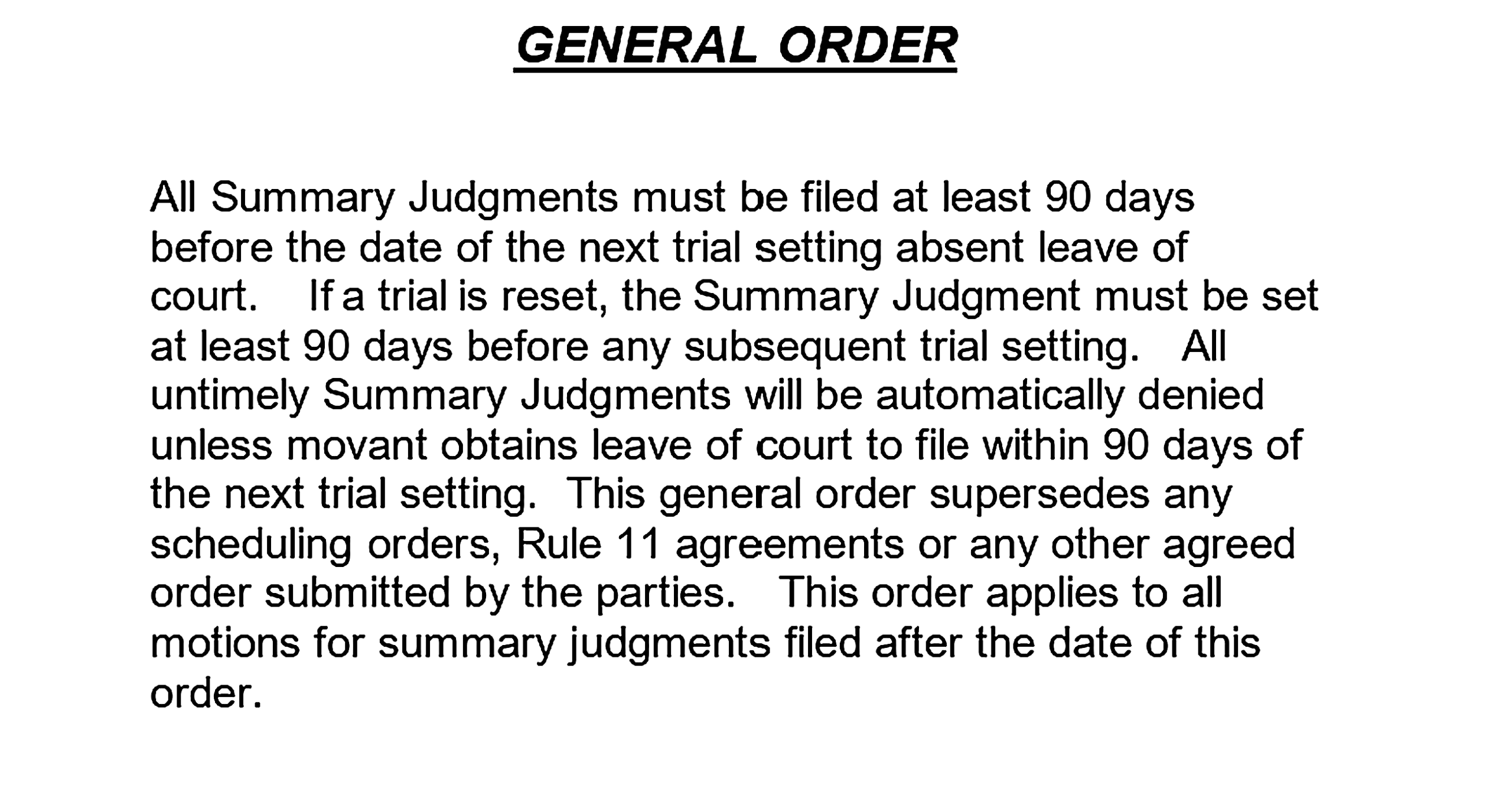
12 of the 13 district judges in Dallas County have joined this order that implements recent changes to the TRCP about summary-judgment practice: