The legend of “Bonnie and Clyde” continues with In re Matter of Parker. A distant relative of Bonnie Parker obtained an order requiring the disinterment of her remains and their reburial by Clyde Barrow’s resting place. (I did not have this dispute on my “bingo card” for 2025.)

The cemetery association appealed and sought to supersede the disinterment order, with the persuasive argument that “[l]eaving the obligations of the parties where they are and the remains of Mrs. Parker where they have been since 1945 perfectly preserves the status quo ….”

As to the law governing this unusual dispute, the Fifth Court held that an appellant subjected to a mandatory injunction is “entitled to supersede a non-monetary judgment” under Tex. R. App. P. 24.1(a). Because the disinterment of human remains is, definitionally, a one-time act that would moot any appellate review, the Court reversed the trial court’s refusal to set security,. TheCourt then fixed the amount of security at zero, noting the appellee’s failure to articulate any compensable harm from a stay, and Mrs. Parker’s lengthy and uninterrupted presence in the cemetery. No. 05-24-00809-CV (Aug. 27, 2025).

The Fischer case discussed last week also addressed fiduciary duties in the context of closely held corporations and post-divorce disputes.

The Court held that, under Texas law, officers and directors of a corporation owe fiduciary duties to the company itself, not to individual shareholders—even when those shareholders are former spouses.

The Court also rejected the argument that a marital relationship or the existence of a divorce decree could create or extend fiduciary duties between former spouses in their capacity as business co-owners.  Once divorce proceedings are initiated, any fiduciary duty arising from the marriage itself is extinguished.

Accordingly, there was no evidence to support the existence of a fiduciary relationship between the parties beyond the formal duties owed to the company. No. 05-23-00679-CV, Aug. 14 2025.

The Fifth Court received these facts in Yancey v. SLJ Co.:

  • In July 2019, SLJ Company, LLC, obtained a $210,096.70 default judgment
    against Yancey, among others.
  • After a January 2021 hearing on SLJ’s motion to appoint a receiver, the trial court appointed a receiver by a single-page order dated April 30, 2021.
  • That receiver took no material actions, and then died in 2013.
  • On December 11, 2023, SLJ filed an application for the turnover of non-exempt property and the appointment of a substitute receiver because the original receiver died.
  • “Two days later, on December 13, 2023, the trial court signed a twenty-five-page order appointing receiver without conducting a hearing or providing notice to Yancey. Attached to the order was an eleven-page exhibit listing documents Yancey was ordered to deliver to the receiver within ten days of receipt of the order.”

The parties received the Court’s conclusion that this order was an abuse of discretion:

The record reveals no “great emergency or imperative necessity” requiring the appointment of a new receiver to replace the deceased receiver without notice or a hearing. n the contrary, the record suggests that no actions were taken with respect to the receivership between April 2021 and December 2023. The transcript of the January 2021 hearing on the first motion to appoint a receiver is in the record, but none of the squabbling over Yancey’s assets contained therein sheds light on her financial affairs nearly three years later in December 2023. Yet the trial court’s order, without notice or a hearing, provided the new receiver with comprehensive powers to assume Yancey’s property was not exempt; enter any real property or other premises where non-exempt property or Yancey’s records might be situated; and “employ reasonable destructive means to bypass or gain access to” non-exempt assets within any real property. 

No. 05-23-01285-CV (Aug. 21, 2025) (mem. op.) (citations omitted).

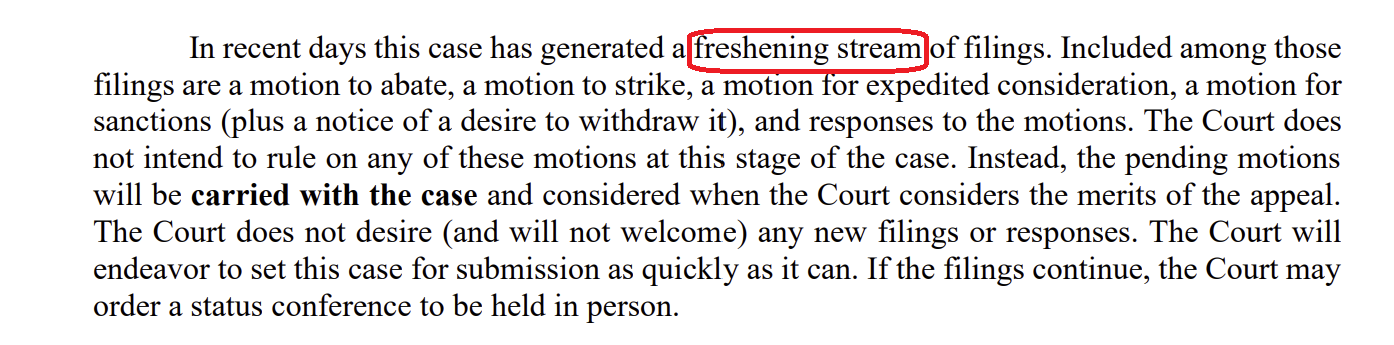
Hon David Gunn of Houston’s First Court of Appeals has given new life to the word “freshening” as an adjective for a frustrating series of court filings (thanks to Ben Taylor for drawing my attention to it):

In Fischer v. Fischer, the FifthCourt applied judicial estoppel to bar an ex-spouse’s post-divorce tort and fiduciary-duty claims.

During the divorce, she argued—and the family court accepted—that a post-marital “Agreement to Convert” stock into community property was “valid and legally enforceable.” After obtaining half of the company shares on that basis, she sued her former husband alleging misconduct tied to those same shares.

The Court noted that judicial estoppel turns on three factors: the party’s prior inconsistent position, success with that position, and the deliberate, unequivocal nature of the original stance. All three were satisfied: by embracing the Agreement to Convert, she “benefited from the divorce court’s acceptance of her position,” namely, a community-property award worth half the company. The Court concluded that her subsequent lawsuit was foreclosed because “all of [her] claims…are claims against converted property,” a position at odds with the estoppel she promised in the Agreement itself. No.05-23-00679-CV, Aug. 14, 2025.

No consideration existed when a purported settlement agremeent “simply stated that Al Jundi owed Plaintiff $224,500 and provided a payment schedule. The agreement contained no mutuality of obligation or bargained for exchange of promises. Plaintiff made no promises under the settlement agreement. It imposed no obligations on him. There was no detriment to him. He stood only to benefit from an additional recourse for recovery of his money. Al Jundi, in promising to pay a debt he did not personally owe, received no benefit.” Al Jundi v. Eljindi, No. 05-23-01121-CV (Aug. 11, 2025).

In Lindberg v. Roskind, the Fifth Court considered – and rejected – the plainitff’s argument that the defendant orchestrated a complex corporate scheme involving Texas-based entities. The Court found no evidence that the defendant himself had any direct contacts with Texas, such as conducting business, maintaining offices, or exercising control over the relevant entities from within the state. The defendant’s uncontroverted declaration established that he was a Florida resident, had not visited Texas in over four years, and had no managerial relationship with the Texas entities during the relevant period.

The Court also distinguished the Texas Supreme Court’s Volkswagen precedent, which found specific jurisdiction based on intentional conduct and a direct distribution system targeting Texas. In that case, there was clear evidence of purposeful conduct directed at Texas, including the use of an established distribution system and direct actions affecting Texas consumers. This record contained no such “nexus” between the plaintiff’s claims and alleged jurisdictional contacts. 05-25-00014-CV, Aug. 11, 2025

Conosir, LLC v. Santos confirms that reliance on an oral misrepresentation is not justified when it is “directly contradicted by the express, unambiguous terms of a written agreement between the parties.”

Here, the parties’ contract at issue unambiguously set forth the terms of a sale, and its merger clause explicitly foreclosed any alternative oral agreements. As a result, the court concluded that the element of reliance necessary for statutory fraud was negated as a matter of law. No. 05-23-01181-CV, July 30, 2025.

The Civil Practice and Remedies Code has provisions that can streamline proof of the reasonableness and necessity of various professional fees. The Fifth Court recently rejected the “argument that an opposing party’s ability to challenge reasonableness or necessity at trial turns on whether it attempted to serve a proper counteraffidavit.”

Acknowleding that in earlier cases, “the defendants … had attempted a counteraffidavit, we conclude that these opinions did not hinge on that fact. Rather, these opinions announced principles that apply even when no counteraffidavit is filed.” And in the leading supreme court case of Allstate, the supreme court “explained that section 18.001 is a ‘purely procedural’ statute that must not be turned into ‘a death penalty on the issue of past medical expenses.'” In re State Farm, No. 05-25-00498-CV (July 30, 2025).

The flight of the Democratic delegation from the Texas House has drawn a great deal of attention. The resulting legal filings in the Texas Supreme Court (Ken Paxton’s here, and these are the petition, response, and reply from the action filed by the Governor) display quality legal writing and excellent font choice. The Governor has chosen a classic look with a Century font, while the Texas Solicitor General uses Equity–generally speaking, a superior font, but perhaps not with the identical margins and spacing that one would use with Century (click here for a side-by-side comparison, which for some reason appears on 600Camp but comes out blurry on this site.)


The designation of a responsible third party after limitations ran was permissible – and its denial, an abuse of discretion, when:

“[Plaintiffs] waited to file suit until two days before the statute of limitations expired and Stonegate was not served with the suit until after the statute of limitations had run. Additionally, according to the record, the discovery period was open until May 23, 2025, and thus, Stonegate filed its February13, 2025 amended disclosures within the discovery period. Stonegate was also required to designate its experts and produce written reports by February 12, 2025, which it did. Furthermore, under [Tex. Civ. Prac. & Rem. Code] section 33.004, the disclosure and motion to designate were filed well before the sixtieth day prior to trial.”

In re Stonegate Contractors LLC, No. 05-25-00693-CV (Aug. 5, 2025).


A contractor conclusively established its claim — and was entitled to reversal and rendition in its favor — in West Tarrant Associates, Inc. v. Lloyd.

As to the contractor’s mechanic’s and materialman’s lien (“M&M” lien), the Court held that, because the contractor had complied with all statutory requirements for perfecting the lien—including timely filing the required affidavit and providing notice to the owner—the trial court had no discretion to deny foreclosure. Once a claimant proves it performed labor for the owner, the debt is valid, and the statutory requirements are met, “the court must order foreclosure under the Section 53.154 of the Property Code.”

On the contract claim, the court found that the owner’s failure to answer the lawsuit constituted an admission of the breach, and the contractor’s invoices provided sufficient evidence of the amount owed to require judgment in its favor. No. 05-24-00314-CV, Aug. 7, 2025

In Alarcon v. Santoyo, the Fifth Court reversed a judgment against a corporate officer, individually, for tortious interference with a contract. Under Holloway v. Skinner, a plaintiff must show that “the defendant officer acted in a fashion so contrary to the entity’s best interests that his actions could only have been motivated by personal interests.” Mixed motives—where an officer’s actions benefit both themselves and the corporation—are insufficient to establish individual liability for tortious interference.

Here, “the fact that Alacorn paid himself a salary as CEO and management fees during this … time period is not sufficient evidence of a personal benefit” from his decisions to pay certain other corporate debts instead of the one involving the plaintiff.  As a result, the Court held that there was no basis for holding the officer individually liable for tortious interference with the contract. 05-24-00297-CV, Aug. 4, 2025.

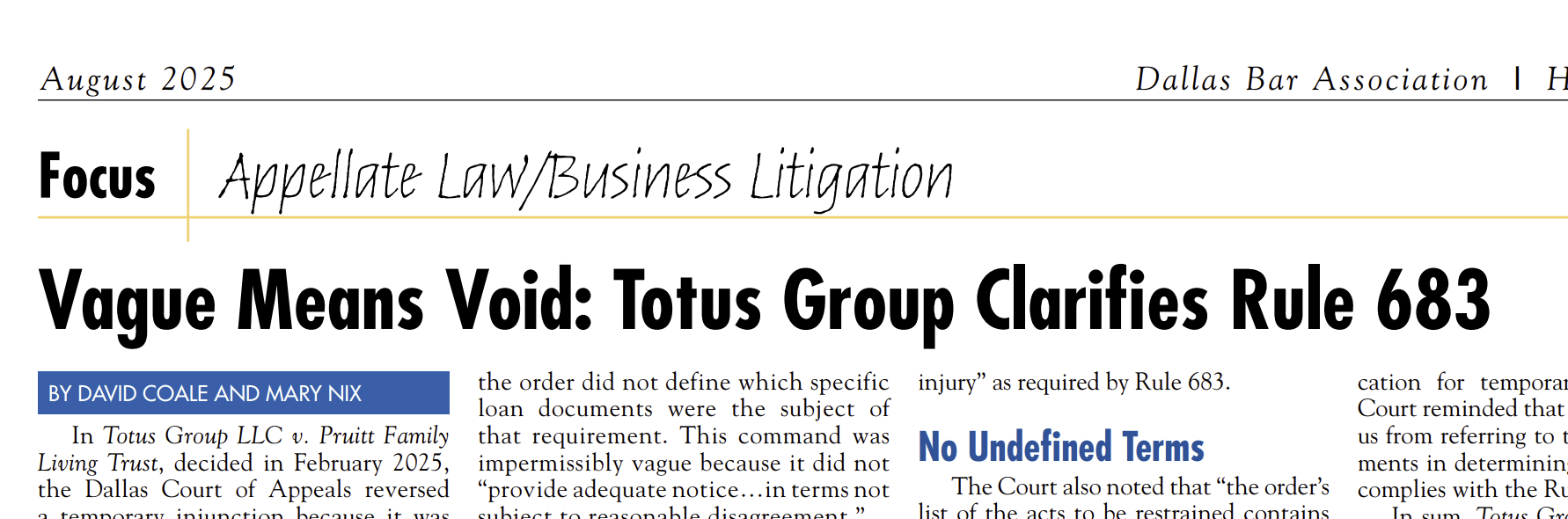
My colleague Mary Nix and I recently wrote an article for Headnotes, the Dallas Bar Association’s monthly publication, about the Dallas Court of Appeals’ most recent analysis of Tex. R. Civ. P. 683.