
On the criminal-law side of the docket, a baffling situation about the number of empaneled jurors led to reversal of a conviction in Leal v. State because “The record matters”:

At oral argument, the absurdity of this scenario was discussed with both counsel for the state and counsel for the appellant. It defies logic that neither the trial judge, nor the bailiff, nor the court reporter, nor either party noticed throughout the entire trial that the jury box was missing a twelfth juror. Yet, the record demonstrates exactly that. A reasonable assumption is that there must have been twelve jurors. But the State attempted to supplement the record to show the presence of and identity of a twelfth juror. The supplementation was unsuccessful in providing this proof.

No. 05-24-00446-CR (Nov. 19, 2025).

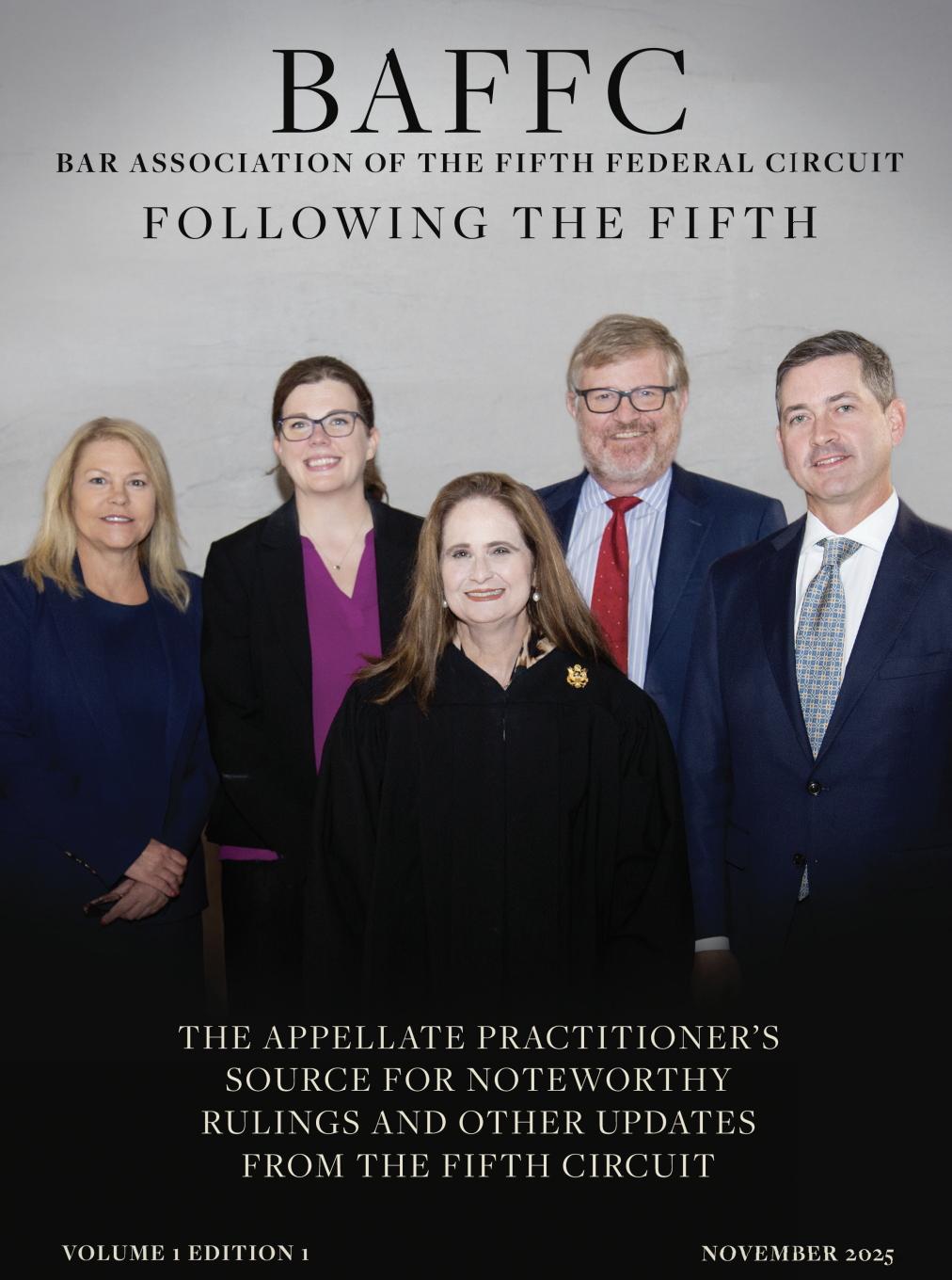
(This is a cross-post from 600Camp) If you aren’t yet a member of the Bar Association of the Fifth Federal Circuit (or “BAFFC” to those in the know) you should join! Our gifted new executive director, Donna Cuneo, led the charge for this awesome new publication, “Following the Fifth” that has general news and also highlights the great work of Krystil Lawton and Walter Woodruff — here is the first edition!

The Texas Supreme Court addressed the important topic of expert testimony about legal issues in In re Lopez. It held that the trial court improperly admitted a former judge’s expert testimony on whether an informal marriage existed because (1) the issue was within the common knowledge of jurors and (2) the witness offered legal opinions and judicial imprimatur (she was a former judge) rather than helpful expertise.

The Court emphasized that the expert repeatedly told the jury how she would rule “wearing [her] judge’s hat,” opined on a legal presumption, and thereby provided “an official endorsement” of one side’s position—testimony Rule 702 does not permit. The Court concluded the error was harmful and ordered a new trial. No. 24-0315 (Tex. Nov. 7, 2025).

Fofanah v. Rockwall Rental Properties clarifies some basic principles about JP court jursdiction over FED actions. The basic rule, of course, is that the JP court has jurisdiction unless there is a dispute about title. These principles, in turn, help define whether a title dispute has been presented:

  • “Under Texas law, a substitute trustee’s deed, the deed of trust, and the notice to vacate are sufficient evidence of the foreclosure purchaser’s superior right to immediate possession in a forcible detainer action. . Any alleged defects in the foreclosure process or with the foreclosure purchaser’s title may not be considered in a forcible detainer action. Those defects may be pursued in suits for wrongful foreclosure or to set aside the substitute trustee’s deed, but they are not relevant in the forcible detainer action.” (citations omitted, emphasis added).
  • “When the issues of title and possession are not so intertwined, the related title dispute may be prosecuted concurrently with the forcible-detainer action in district court. This remains true ‘even if the other action adjudicates matters that could result in a different determination of possession from that rendered in the forcible-detainer suit.”
  • “One indication that a county court on appeal is called on to exceed its jurisdiction by adjudicating title to real estate in a forcible-detainer action is when a landlord-tenant relationship is lacking.”
  • “’Title and possession issues are not inextricably intertwined if “the contract provides for a landlord-tenant relationship upon default, that the buyer becomes a tenant by sufferance in the event of default, or that the buyer is subject to a forcible-detainer suit upon default.”‘ A tenant-at-sufferance clause in a deed of trust separates the issue of possession from the issue of title.”

No. 05-24-01265-CV (Nov. 7, 2025).

The Fifteenth Court’s recent opinion in State of Texas v. Yelp is a good summary of Texas personal-jurisdiction law about online activity.

Texas sued Yelp under the DTPA, alleging that Yelp appended a “Consumer Notice” to the business pages of crisis pregnancy centers, including more than 200 in Texas, that misled Texas consumers. Yelp specially appeared.

The Court found that Texas did not adequately plead general jurisdiction. Raising a theory of “consent by registration” in response to the special appearance did not qualify as raising the issue in a pleading, as required in this procedural context.

While the Court did not reach the issue, it  showed skepticism toward reading Texas’s registration statutes as conferring consent to general jurisdiction.

  • After the Supreme Court’s 2023 Mallory opinion, Texas intermediate appellate courts have held that, unlike the Pennsylvania statute in that case, Texas’s business-registration framework does not expressly condition registration on consent to all-purpose jurisdiction (either in the long-arm statute or the registration statutes).
  • Section 9.203 of the Business Organizations Code, cited by some plaintiffs in this regard, has been read to equalize “duties, restrictions, penalties, and liabilities” of foreign and domestic entities in matters affecting intrastate business – not to  transform registration into blanket consent to suit.

Texas did establish specific jurisdiction, concluding that:

  • Purposeful availment requires conduct that is … purposeful: not random or fortuitous, and designed to secure benefits in the forum. state Yelp’s location-specific curation, ad sales, and Texas market cultivation fit the bill.
  • “Relatedness” does not demand a strict causal chain. It is enough that the suit “arises out of or relates to” the Texas-directed conduct. The Texas-focused placement of the Consumer Notice and its alleged effects on Texas consumers satisfied that standard.
  • Nationwide conduct does not defeat forum relatedness. A defendant need not uniquely single out Texas if it deliberately includes Texas in its targeted markets.
  • Internet presence alone is insufficient, but internet targeting matters. The Court distinguished cases about general news content, accessible in Texas, from conduct aimed at Texans seeking services in Texas.

No. 15-24-00040-CV (Oct. 16, 2025).
Contempt was inappropriate in the following situation:

“[T]he trial judge found ‘that certain terms of the divorce decree are not specific enough to be enforced by contempt and should be clarified.’ He then clarified the order to include the specific date, time, and address for Le to comply with the payment obligation. Despite correctly finding that the provision lacked sufficient clarity to be enforced by contempt, the trial judge nevertheless found Le in contempt of that same provision without providing adequate notice or a reasonable time for him to comply with the clarified order. Because Le did not have notice or a reasonable time to comply with the Clarification Order, the trial court’s finding that he acted with ‘willful disobedience to or disrespect of a court by acting in opposition to its authority’ was arbitrary, unreasonable, and without reference to any guiding rules or principles.”

In re Le, No. 05-25-00019-CV (Oct. 29, 2025).