The Fifth Court reversed a judgment about an alleged violation of a restrictive covenant by a “tiny house” when:

The Morrisseys’ original petition was their live pleading at the time the trial court granted their motion for summary judgment. Despite the recitations in the trial court’s judgment, the Morrisseys’ original petition failed to allege the Czegledis violated a restrictive covenant concerning square footage. Finally, the Czegledis timely argued that it would be unjust to grant summary judgment based on an unpled allegation; thus, the parties did not try the Morrisseys’ allegation concerning minimum square footage by consent. Therefore, our de novo review reveals the trial court’s summary judgment is void because it is not supported by the Morrisseys’ live pleading.

Czegledi v. Morrissey, No. 05-24-00739-CV (Dec. 15, 2025) (citations omitted).
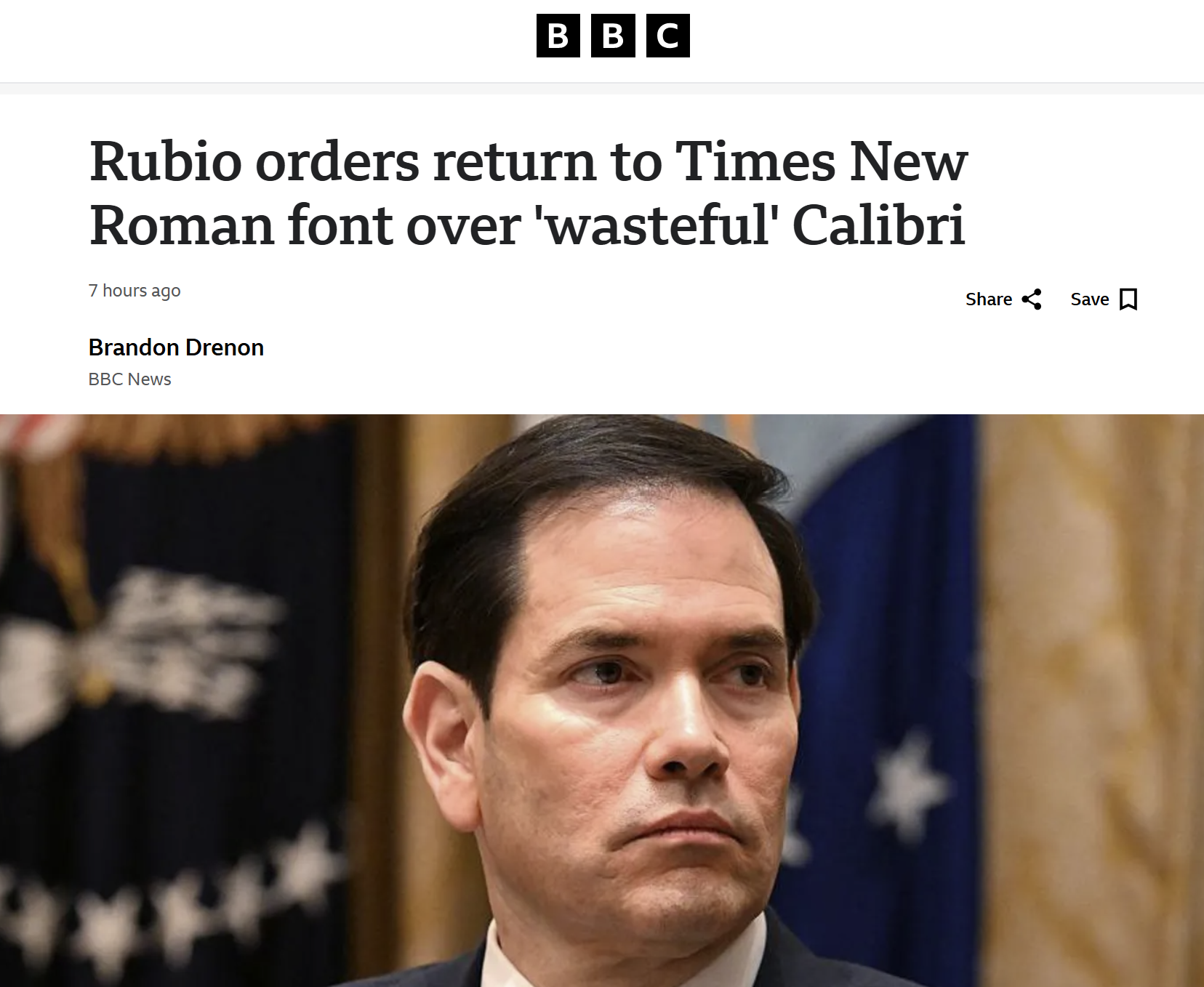
Font selection has global consequences, as the State Department returns to Calibri from Times New Roman (imho, the State Department should jettison both fonts and use a tasteful modern serif font, such as Equity or Book Antigua).

The Fifth Court reversed the grant of a Rule 91a motion to dismiss in Skibell v. Fobare, reminding: “When considering pleading sufficiency, the Supreme Court of Texas has repeatedly concluded that a pleading provided fair notice of a claim despite it not including the specific name for that claim,” and citing these two paragraphs from the plaintiffs’ 10-paragraph petition:

No. 05-24-00723 (Dec.8, 2025) (mem. op.).

The Texas Supreme Court recently reminded that, in addition to the 3-factor Craddock test for when a new trial is required after a default judgment, the “ordinary” motion for new trial is also available as an option:

“Even if a defendant does not satisfy the Craddock test, a trial court has broad discretion to determine that another ground identified in the defendant’s motion constitutes ‘good cause’ to order a new trial following a default judgment. See TEX. R. CIV. P. 320. This is so because such judgments are disfavored and “differ from every other kind in a fundamental way.” In re Lakeside Resort JV, LLC, 689 S.W.3d 916, 920 (Tex. 2024).”

Tabakman v. Tabakman, No. 24-0919 (Tex. Dec. 5, 2025).