In Badiee v. Mahboubi, the Fifth Court affirmed a take-nothing judgment for the defendants in a suit for unpaid accounting fees, holding that the trial court did not abuse its discretion in excluding “updated invoices” the plaintiff offered under the business-records exception of Texas Rule of Evidence 803(6).

All the invoices were dated December 31, 2022 — after the parties’ fee dispute had arisen — and many described work performed in earlier years, some more than a decade before trial. The plaintiff testified that the invoices were created in QuickBooks as a regular practice when partial payment was received and that the underlying invoices were still available. On that record, the Court concluded that the records “were not made at or near the time of a regularly conducted business activity” within Rule 803(6)’s requirement. (The Court also found no harm, because the jury had already found a flat-fee agreement covering all of the plaintiff’s services, so any hourly-billing detail in the excluded invoices would have been cumulative on the central liability question.) No. 05-25-00334-CV (May 13, 2026)

In African Contract Solutions, Inc. v. Bradley Arant Boult Cummings, LLP, the Fifth Court applied Texas’s anti-fracturing rule to affirm the Rule 91a dismissal of breach-of-fiduciary-duty and fraud claims against a law firm and its individual lawyer. The court held that the gravamen of the suit was legal malpractice and that the claims were therefore subject to — and barred by — the two-year statute of limitations applicable to professional-negligence claims:

[T[he crux of appellants’ complaint is that appellees’ representation of GSGS was deficient because of the conflict of interest in advising Sturm or placing Sturm’s interests over the interests of GSGS, i.e. appellees failed to advise GSGS of Sturm’s adverse actions, which negatively affected GSGS. The allegations involve the question of whether appellees failed to exercise the degree of care, skill, or diligence in performing their duty to inform their client (the company) under professional conduct rules about issues concerning the company’s allegedly rogue president, who hired appellees to represent the company.

. The opinion follows the Texas Supreme Court’s recent guidance in Pitts v. Rivas, 709 S.W.3d 517 (Tex. 2025), and reaffirms that the anti-fracturing rule blocks plaintiffs from recharacterizing a malpractice claim “in order to obtain a litigation benefit like a longer statute of limitations.” No. 05-24-01244-CV (May 11, 2026).

In MV Transp. v. GDS Transp., the Texas Supreme Court (reversing the Fifth Court on the merits) addressed a threshold evidentiary question–whether the apparently inadvertent omission of a contract central to a Rule 91a dismissal motion from the appellate record precluded appellate review.

The contract at issue—a master agreement between a public-transit authority and a private operator—formed the basis of the plaintiff’s claims and was purportedly attached to the live pleading as an exhibit, yet it never made it into the record on appeal. The Court acknowledged that “[p]arties should, of course, ensure that materials they themselves recognize as essential to their dispute are included in the record so that appellate courts can more readily perform their function of reviewing trial-court judgments”. Nevertheless, the Court held that the omission did not bar review, for two reasons.

The Court offered two reasons. First, when a petition invokes a document as a basis for relief, the document is not mere “evidence” but may be regarded as part of the petition itself under Texas Rule of Civil Procedure 59, and nothing in Rule 91a suggests that dismissal would be improper simply because such a document is missing from the record.

Second, the parties fully agreed about the master agreement’s material terms; they disputed only the legal consequences of its text, “and that kind of dispute lies in Rule 91a’s heartland”. Because the plaintiff’s own allegations amply described and quoted the agreement’s relevant provisions, the Court concluded that it could test the legal viability of the claims without the full document in the record. No. 24-0924, May 8, 2026.

Reversing the Fifth Court, in Ortiz v. Nelapatla, the Texas Supreme Court analyzed a medical-expense affidavit that was only partially challenged by a counteraffidavit.

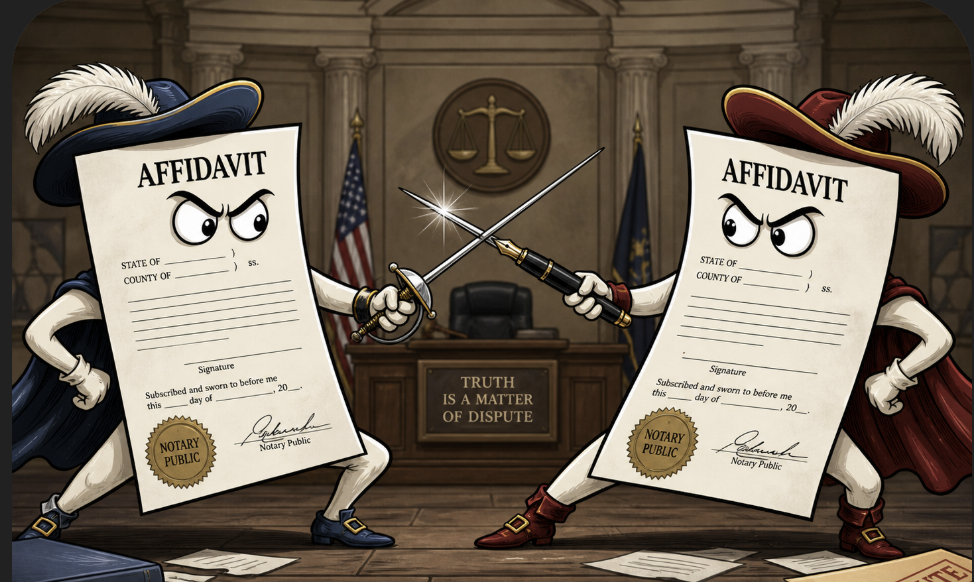
The supreme court held that “the unchallenged portions of the medical costs identified in the initial affidavit remain competent evidence and may be submitted to the factfinder.” The controverted portions must be redacted or otherwise set aside, but the uncontroverted portions — and, where appropriate, the counteraffidavit itself — remain admissible to prove that the unchallenged amounts were reasonable and necessary. No. 23-0953, May 1, 2026.