In Your Problem, My Solution, LLC v. Guel Family Builders, Inc., the Dallas Court of Appeals reversed and remanded a summary judgment in a title dispute; in so doing, the court addressed a procedural argument that the panel’s earlier denial of mandamus on a related lis pendens issue had become the law of the case.

The Court explained that under the law-of-the-case doctrine “questions of law decided on appeal to a court of last resort govern the case throughout its subsequent stages,” and that a denial of mandamus “without comment on the merits does not bind an appellate court from considering the matter in a subsequent appeal.” The earlier mandamus opinion had “simply set out the law regarding mandamus relief” and concluded the relator had “failed to demonstrate entitlement to mandamus relief” — not that the underlying lis pendens or title positions were correct. No. 05-24-01467-CV (June 15, 2026).

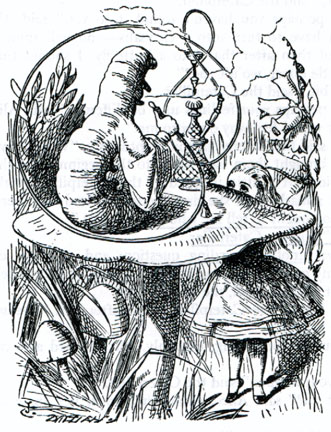
In Wonderland, Alice was able to resolve a question about hookah use by speaking to the Caterpillar. Unfortunately for the plaintiffs in City of Irving v. The Living Room Irving, the Fifth Court concluded that they could not have an answer to their hookah-related question —  the lounges had pleaded “ultra vires” about a new smoking ordinance against the City of Irving but did not name as a defendant any city officer in an official capacity.

The Court reminded that the Declaratory Judgments Act “does not enlarge a trial court’s jurisdiction” and that even with the ultra vires exception allowing suit against an officer in his or her official capacity, the “governmental entity itself remains immune from suit,” citing City of El Paso v. Heinrich, 284 S.W.3d 366 (Tex. 2009). Because the lounges’ pleadings did not affirmatively demonstrate jurisdiction, the claims were dismissed. No. 05-25-01240-CV (June 8, 2026).

In Trojan Tubular Services, LLC v. Legacy Exploration, LLC, the Fifth Court reviewed whether the TCPA applied to several claims about a company’s efforts to resolve a lawsuit, and ruled, inter alia, as follows.

  • The TCPA does not apply to claims based on paying money for a judgment, because paying money is not a “communication” as the TCPA defines that term and thus is not an exercise of the right to petition or free speech.
  • The TCPA does not apply to statements disparaging a competitor to its investors (e.g., “do not waste your money on Legacy” or “Legacy is about to go bankrupt”), because the movants did not show those statements involved a matter of public concern or a governmental proceeding—the prerequisites for the rights of association and free speech
  • The TCPA does apply, however, to the alleged statement that the movants “were going to prevail” in pending federal litigation. The court held that “a prediction of the outcome of a lawsuit, made by litigants in that very lawsuit, relates directly to, concerns, or has to do with that lawsuit,” making it an exercise of the right to petition. (The Court went on to find that the motion was untimely on this claim).

No. 05-25-00538-CV (June 4, 2026),

In CTR Incident Management Specialists, LLC v. Jet Stream Trucking, Inc., the Fifth Court reversed a lost-profits award in favor of a Dallas-area towing and recovery business.

The dispute arose out of a falling-out between the towing company’s owners and a new entrant whose entities, the court found, drew away the established company’s customer relationships.

On the one hand, Appellants argued that “[Plaintiff] did not calculate lost profits but instead provided the jury with a list of assets and expenses and characterized his calculations as a ‘quick draw; or ‘estimates.'” Accordingly, they contended, “there  nothing in the record that substantiates the amount testified to by Saleh or the amount awarded by the jury, which was different than the amount appellees sought.”

On the other hand: “Appellees respond that the evidence showed Kyle continued to operate the business and retained all of the profits for himself instead of buying out his partners’ interest in the business.” Therefore, argued Appellees, “the jury properly found that the new company—CTR 2—was merely doing business as the old company and, thus, appellees were entitled to their share of profits from the new business. Appellees contend they established CTR 2’s profits through appellants’ business records and established Saleh and Ghazi were entitled to seventy-five percent of those profits.” No. 05-24-01047-CV (June 5, 2026).

In Boss Exotics, LLC v. Chappell, the Dallas Court of Appeals reversed a dismissal for want of prosecution following a restricted appeal, holding:

  • There was no failure to appear at a hearing or trial setting under Rule Tex. R. Civ. P. 165a(1);
  • The case had not exceeded any applicable time standards under Rule 165a(2); and
  • The trial court “did not provide an opportunity to be heard on the dismissal” before signing it.

The panel also held that any reliance on the court’s inherent authority to dismiss could not save the order, because the trial court “provided no notice of an intent to dismiss under its inherent authority” either. No. 05-24-00428-CV (June 1, 2026).

In State of Texas v. City of McAllen, the Texas Supreme Court dismissed a lawsuit in which a group of cities challenged state statutes that reduced the fees cities can charge telecommunications companies for using public rights of way. The cities claimed that charging below-market rates amounted to an unconstitutional gift to the telecom companies under the Texas Constitution’s Gift Clauses. The Court vacated the lower courts’ judgments “without addressing the Gift Clauses at all” because the case “suffers from a basic defect that has deprived the courts of jurisdiction from the beginning: The cities sued the wrong defendant.”

The Court held that naming the “State of Texas” as defendant was insufficient. A plaintiff challenging a statute’s constitutionality must “identify and name the officer or agency with authority to enforce the challenged law” so a court can direct its judgment at the entity whose actions caused the injury. Naming the State is “not a cheat code for bypassing the requirement, incumbent on any plaintiff in any context, to seek a judgment against the party whose actions are the cause of the alleged injury.” The Court noted that no state officer or agency had taken or threatened any adverse action against the cities.

The Court further explained that the real dispute was between the cities and the telecom companies over how much the companies must pay to use public property. But because the cities did not sue the telecom companies, any judgment would not bind them. The companies “would be well within their rights to ignore a sweeping declaration against the ‘State of Texas’ in a lawsuit to which they were not parties and to insist on a judgment binding on them before they assent to the higher rates sought by the cities.” Therefore, because the judgment sought “would not redress the cities’ injury or resolve the real-world dispute animating this litigation,” the case was beyond the courts’ jurisdiction. No. 24-1060 (Tex. Jun. 5, 2026).

In Sana Healthcare Carrollton, LLC v. Baylor Medical Center at Carrollton, the Fifth Court held that a broad mutual release in the parties’ 2021 “Compromise Settlement Agreement” removed the buyer’s obligation, under an earlier Operations Transfer Agreement, to remit approximately $4.5 million in Medicare and Medicaid reimbursements to the sellers.

The Fifth Court noted that the Settlement Agreement’s “Termination of Prior Contractual Relations” section expressly terminated the OTA “except for the obligations provided for in this Agreement,” and the reimbursements were not among them. The agreement also contained a broad reciprocal release and a merger clause stating that the settlement “supersedes any and all other prior agreements of the Parties.” And, the Medicare reimbursements appeared nowhere in the settlement.

Citing Southwestern Electric Power Co. v. Burlington N. R.R. Co., 966 S.W.2d 467 (Tex. 1998), the court also rejected the sellers’ fallback theory of unjust enrichment, reasoning that express contract terms terminating a payment obligation foreclose an equitable claim bsaed on the same payments. No. 05-25-00077-CV (May 27, 2026).

The Texas Supreme Court held in Bryant Law Firm v. Walker that a party cannot avoid an accord and satisfaction by crossing out release language on a check and then depositing it anyway.

An attorney refunded fees to a former client, with a check, on which the “memo” line said that cashing it “represents a full & final settlement and release of all claims.” The client crossed out that language before depositing the check and later sued the attorney for additional damages.

The Court found that the elements of the statutory accord and satisfaction defense under Texas Business and Commerce Code Section 3.311 were conclusively established: the attorney tendered the check in good faith as full satisfaction, a bona fide dispute existed as to the amount owed, the check contained a conspicuous statement of release, and the client obtained payment with actual knowledge of the condition.

Striking through the notation on a check “does not relieve [the payee] of the legal consequence of negotiating it and depositing it into his account.” Relying on more than a century of precedent, the Court reaffirmed that mutual assent is satisfied when a party accepts a negotiable instrument with knowledge it is offered as full payment and then proceeds to negotiate it. No. 25-0131 (Tex. May 8, 2026).