glendonTodd Capital v. Smith holds that a loan provision requiring the borrower to sell the lender a percentage interest in a related limited partnership was an “option or right to purchase” equity under the Texas Finance Code — and therefore, could not be usurious interest. No. 05-25-00897-CV (Sept. 9, 2026). LPHS represented the unsuccessful appellant in the matter.
Monthly Archives: September 2026
Below, a cross-post from 600Camp on its 15th birthday!
 600Camp celebrates its 15th birthday with this, the 2810th post. Thanks to everyone who has joined this fascinating journey. To celebrate this anniversary properly, I observe three 600Camp traditions:
- Valuable 600Camp Merchandise. Anyone who catches an error in a post goes on the list to receive valuable 600Camp merchandise. Unfortunately I still do not yet have any merchandise, but I assure you that all such commitments will be duly honored at the earliest possible time.
 Update on the M/V OCEAN SHANGHAI. The 2013 case of Farenco Shipping Co. v. Farenco Shipping PTE, Ltd. produced the best mootness argument of all time — a case about the seizure of a marine vessel became moot once the ship had sailed. The M/V OCEAN SHANGHAI, since renamed as SFERA, has avoided the Fifth Circuit’s waters ever since; as of September 21, 2026, it was anchored in the Gulf of Finland not far from Saint Petersburg (right). .
- Creole Cuisine. The Fifth Circuit is blessed to be headquartered in the culturally rich city of New Orleans; to celebrate 600Camp’s birthday properly, you should make some shrimp remoulade using the legendary recipe from Galatoire’s.
 Sunoco v. Trinity Industries addressed this novel issue: whether a railcar lease required the lessee to pay for federally mandated railcar modifications, even though the lessee had taken its railcars out of service before the modifications became mandatory. The Fifth Court reversed a $15.4 million judgment against the lessee.
The contract required the lessee to pay for modifications “required” by a change in “car design, specification, or appurtenances” ordered by a governmental authority. The federal “FAST” Act and related regulations mandated upgrades to certain kinds of tank cars, butthe lessee had already taken its cars out of service after oil-price changes made rail transport uneconomical. It continued paying rent but refused to pay for the modifications, contending the mandate did not apply to parked cars.
The Court held that the federal statute’s phrase “used to transport” is dispositive, and means that “modifications are required only if the railcars are actually being used to transport crude oil.” The court found this reading consistent with the safety purpose behind the mandate, reasoning that “[t]here would be no safety reason to upgrade railcars not in service …” No. 05-24-00468-CV (Tex. App.—Dallas Aug. 31, 2026, no pet. h.) (mem. op.), LPHS represented the successful appellant in this matter.
 In Sebastian Construction v. Chand, the Fifth Court of Appeals at Dallas reversed and rendered a take-nothing judgment against a general contractor after it had lost a $1 million judgment to neighboring landowners.
Sebastian Construction did work on property near a dam. The neighbors had a pond on the other side of the dam. The neighbors alleged that Sebastian’s work changed the natural support of the area, damaging their pond.
The Court applied Texas’s “doctrine of lateral support”—traditionally, a duty not to remove the support of adjoining land and thereby cause subsidence—and held that it did not apply to water migrating out of a pond, as opposed to water or debris migrating onto a plaintiff’s land. No. 05-25-00090-CV (Tex. App.—Dallas Aug. 25, 2026).
The http://U.S. Court of Appeals for the Fifth Circuit and the Bar Association of the Fifth Federal Circuit both have stylish new websites!
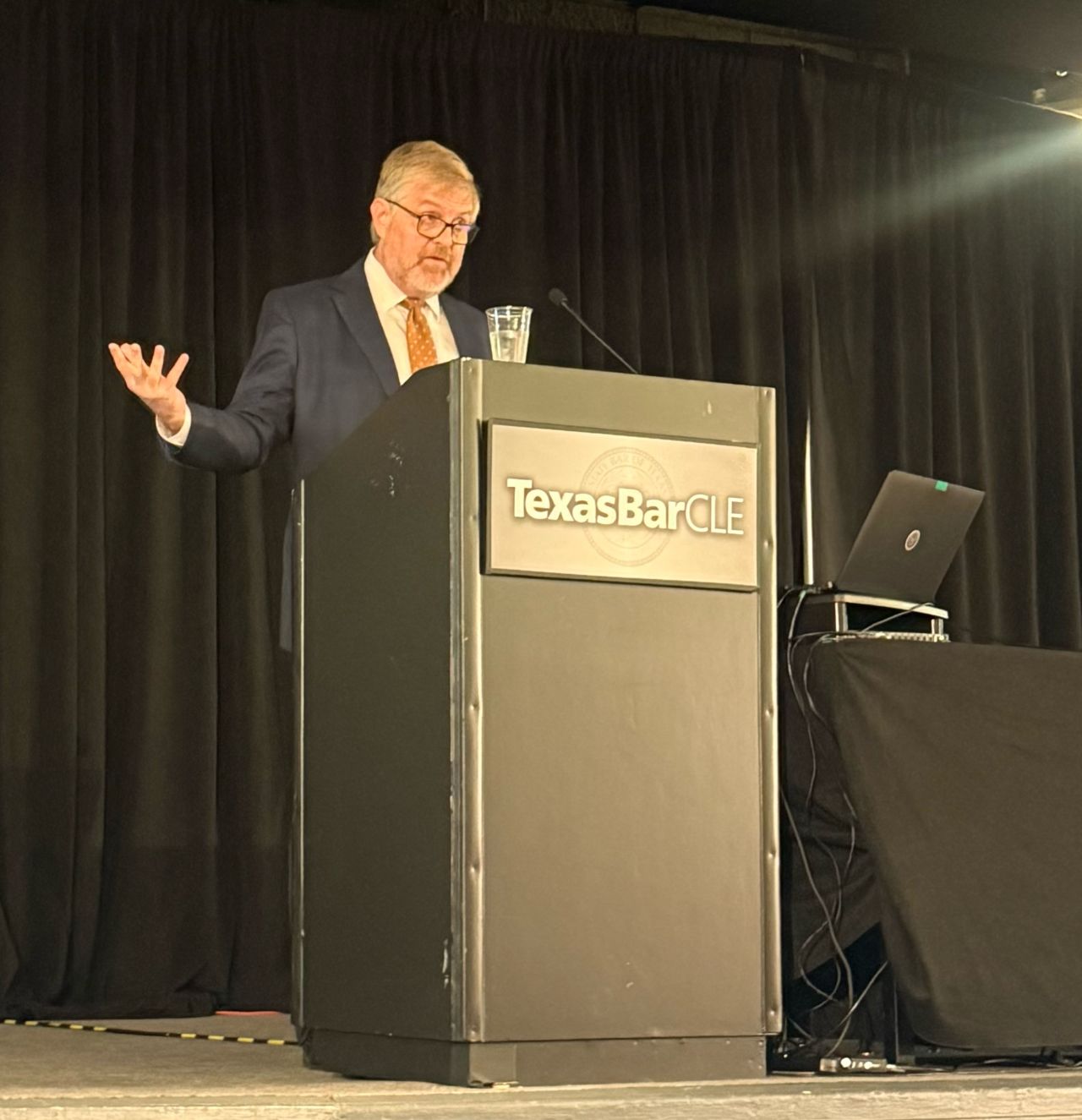 Here is a copy of my PowerPoint from last week’s Advanced Civil Trial course in Austin, where I gave an update on the work of the Texas Supreme Court in its 2025-26 term.
 In Qu Food Express LLC v. Yomie Yogurt LLC, the Fifth Court affirmed a judgment based on a commercial lease, despite a lack of signatures, when legally sufficient evidence nevertheless established that a “meeting of the minds” occured.
Citing precedent that signatures, while often evidence of mutual assent, “are not essential” to form a binding contract, the Court concluded that the parties demonstrated their intent to be bound through other conduct. Specifically, both parties’ representatives initialed all 34 pages of the lease in each other’s presence, the landlord’s agent told the tenant the lease “is already effective,” and both sides performed under the lease for months, with the tenant timely paying the agreed-upon rent amount and the landlord depositing those payments.
The defendant testified that the parties had not reached a final agreement, but because the above amounted to more than a scintilla of evidence to support the trial court’s finding, the Court affirmed No. 05-25-00425-CV (Aug. 28, 2026).